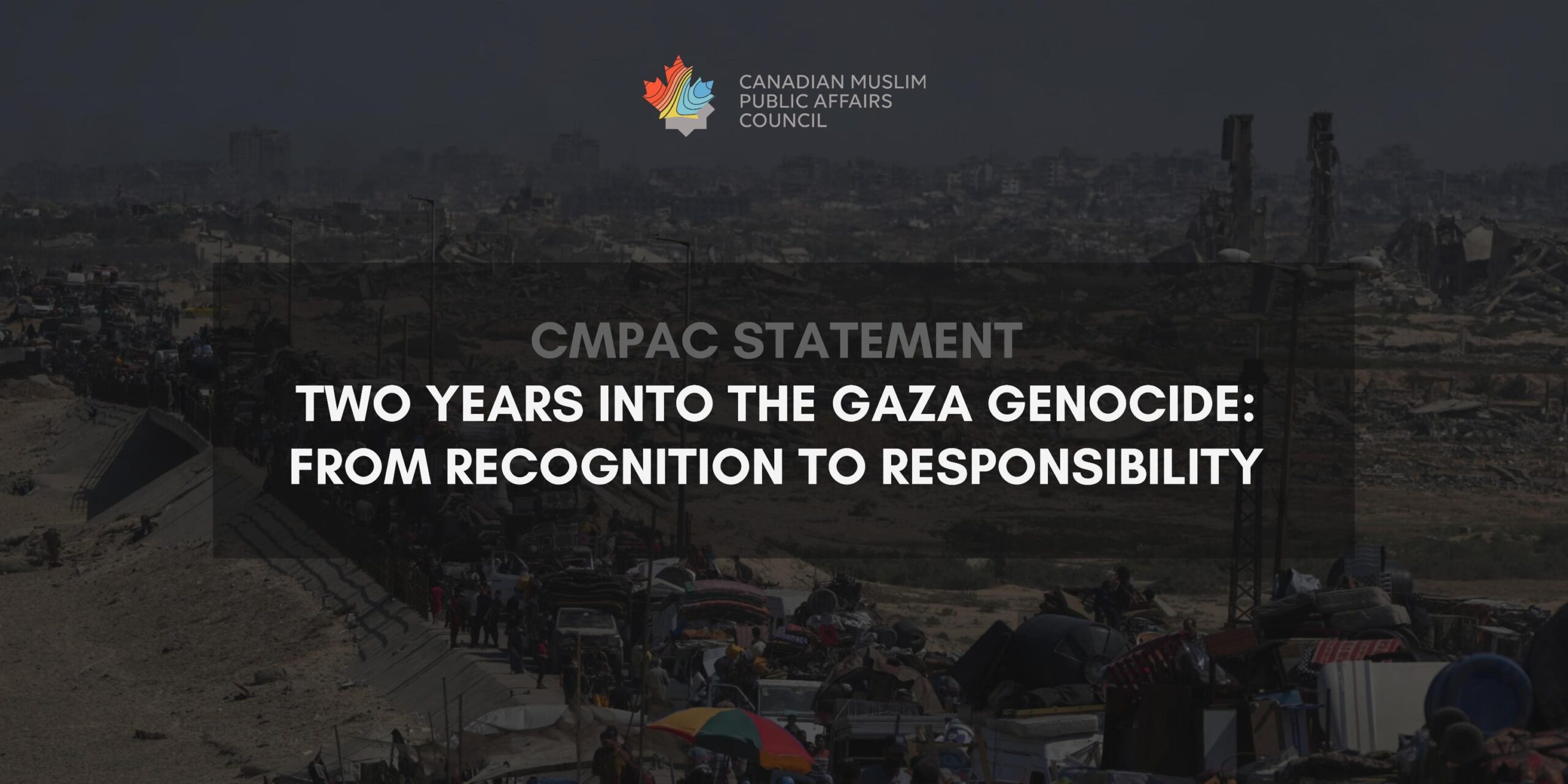
Tuesday, October 7, 2025 – Today marks two years since the beginning of Israel’s genocidal assault on Gaza, the deadliest and most destructive campaign against Palestinians in modern history. According to the Ministry of Health in Gaza, at least 66,148 Palestinians have been killed and 168,716 injured since October 7, 2023, including 269 malnutrition-related deaths,112 of whom were children. Repeated displacement, the collapse of basic services, and destruction of infrastructure have pushed the population into repeated cycles of deprivation.
Famine is no longer a looming threat. It has been “irrefutably confirmed” in Gaza by UN agencies (OCHA, OHCHR, WFP, WHO). At the end of September 2025, over 640,000 people were projected to face IPC Phase 5 (catastrophic food insecurity), with 1.14 million in Phase 4 (emergency) and 396,000 in Phase 3 (crisis). These figures reflect severe famine conditions, extreme food deprivation, acute malnutrition, and hunger-driven deaths, sustained by the blockade, destruction of infrastructure, and restricted aid access.
Leading international bodies, including the UN Human Rights Council, Amnesty International, Human Rights Watch, and UN Special Rapporteurs, have repeatedly identified Israel’s actions as meeting the threshold for genocide under the Genocide Convention. The International Court of Justice (ICJ), in its Provisional Measures Order (January and March 2024), concluded that South Africa’s case against Israel for genocide is plausible and ordered Israel to prevent genocidal acts and allow unhindered humanitarian access. These orders remain unheeded, with devastating consequences for civilians in Gaza.
Humanitarian and Structural Collapse
Two years on, Gaza remains a site of systemic annihilation. Hospitals have been targeted and destroyed; only a handful remain partially functional, operating without anesthesia, electricity, or basic supplies. According to the World Health Organization (WHO), 22 of 36 hospitals are shut down, and 14 are only partially operational as of October 4, 2025. Education is at a standstill, with 87.7% of schools damaged or destroyed, denying over 600,000 children their right to learn. Shelter and sanitation conditions are dire, with over 1.7 million people living in tents or ruins. Disease and malnutrition are widespread, with 74 malnutrition-related deaths reported in 2025 alone.
This crisis results from Israel’s deliberate state policy. The blockade, bombardment, and displacement are instruments of erasing Palestinian life and identity, compounded by collective punishment in violation of the Fourth Geneva Convention.
Resilience, Resistance, and Global Solidarity
Despite catastrophic conditions, Palestinians continue to exercise their inalienable right to resist occupation, as affirmed in UN General Assembly resolutions 37/43 and A/RES/3246, which recognize the legitimacy of struggles for liberation. This resistance is closely linked to the resilience of Palestinians as they rebuild homes, teach in bombed schools, care for the wounded, and document war crimes. These acts express both the determination to survive and the political will to live freely on their land. Globally, solidarity movements amplify this resistance. The Freedom Flotilla Coalition, including the Handala, Madleen, and Global Sumud, defies Israel’s unlawful blockade through nonviolent direct action, carrying both aid and the moral weight of international conscience.
Canada’s Role: Recognition without Responsibility
In September 2025, Canada formally recognized the State of Palestine, a symbolic and overdue acknowledgment of Palestinian nationhood. Yet recognition alone cannot absolve Canada of ongoing complicity in Israel’s genocide. Canada continues to maintain trade through the Canada-Israel Free Trade Agreement (CIFTA), including products from illegal Israeli settlements; allowing military and dual-use exports to flow through regulatory loopholes; and advancing legislation such as Bill C-9, which risks criminalizing advocacy for Palestinian rights under the guise of combating hate. Recognition without accountability is performative. Canada cannot profess support for peace while enabling an apartheid regime’s ethnic cleansing and destruction of an entire people.
Our Calls to Action
As a signatory to the Genocide Convention and the Rome Statute, Canada bears legal and moral duties to prevent, not merely condemn atrocities. CMPAC and allied organizations call on the Government of Canada to:
- Implement a Comprehensive Two-Way Arms Embargo: Halt all military exports to Israel and close loopholes that allow indirect transfers of weapons, ammunition, or military technology, as outlined in MP Jenny Kwan’s Private Member’s Bill to Close Loopholes in Canada’s Arms Export Laws.
- Cancel CIFTA and Apply Diplomatic Pressure: Canada must end its complicity in Israel’s violations of international law by cancelling the Canada-Israel Free Trade Agreement (CIFTA) and other arrangements that legitimize illegal settlements. This should be paired with targeted sanctions and diplomatic pressure to end the occupation, settlement expansion, and Gaza blockade.
- Lift the Blockade, Support Humanitarian Relief and Commit to Reconstruction of Gaza: Use diplomatic leverage to end the blockade and fund rebuilding of homes, hospitals, schools, and critical infrastructure, enabling Palestinians to rebuild with dignity. This should be coupled with increasing support for UNRWA, WHO, and independent NGOs providing essential aid to Palestinians.
- Ensure International Accountability: Fully support ICC investigations and ICJ recommendations, holding perpetrators of war crimes and crimes against humanity accountable.
- Protect the Right to Advocate for Palestine: Withdraw Bill C-9 and safeguard Canadians’ constitutional rights to freedom of expression, peaceful protest, and solidarity work. End the stigmatization and criminalization of Palestinian advocacy in media, academia, and public discourse.
A Call to Global Conscience
Two years into Israel’s genocide in Gaza, the world continues to face a defining moral test. The genocide of an entire society cannot be normalized as war. Canada’s recognition of Palestine must translate into responsibility through sanctions, accountability, and protection of human rights at home and abroad. We, the undersigned, renew our commitment to justice, freedom, and dignity for the Palestinian people. Resistance to genocide is not only a right; it is a duty shared by all who believe in humanity.